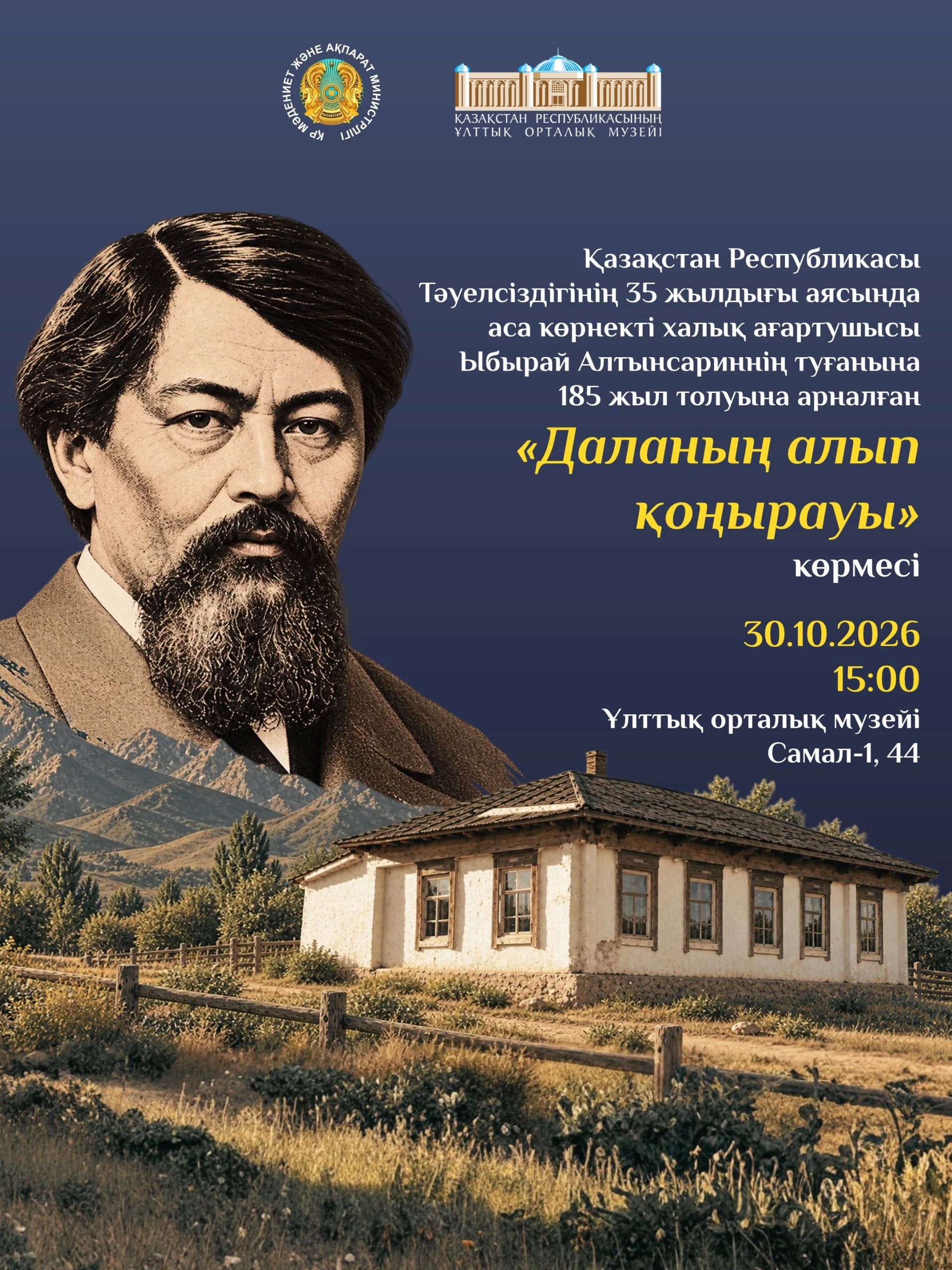
On October 30 of this year at 3:00 PM, the National Central Museum of the Republic of Kazakhstan will host the opening of the thematic exposition exhibition "The Great Bell of the Steppe" ("Даланың алып қоңырауы"), dedicated to the 185th anniversary of the birth of the prominent educator Ibray Altynsarin. The event is held as part of the celebration of the 35th anniversary of the Independence of the Republic of Kazakhstan.
Ibray Altynsarin (1841-1889) gained widespread recognition as an innovative educator in the history of public thought, culture, and literature of the Kazakh people, an organizer of modern-type schools, an ethnographer, folklorist, poet, prose writer, and translator of Russian classical literature.
In the field of education, the innovative teacher wrote two textbooks for students of Russian-Kazakh schools: "The Kyrgyz (Kazakh) Chrestomathy" and "Primary Manual for Teaching the Russian Language to Kyrgyz (Kazakhs)". He authored widely known fables such as "A Tuft of Cotton", "The Crooked Tree", "The Pure Spring", "Mother and Child", "The Foolish Friend", "The Mange Boy", "Kipshak Seitkul", "The Benefits of Curiosity", "Garden Trees", "Healing Herb", "The Kind Boy", "How to Get Rich", "Zhirenshe Sheshen", "The Bai's Son and the Poor Man's Son", "Father and Son", "The Doll and the Cat", as well as famous poems including "Let Us Learn, Children!", "The Benefit of Knowledge", "The River", "Summer", and others.
 The highlight of the exhibition is Ibray Altynsarin’s personal pocket watch (manufactured by Pavel Buhre), presented to the museum in 1989 by his fellow countryman, Serik Zhamantayevich Uakbayev. The exposition features original and photocopied photographs – collected in 1959 during an expedition of the Central State Museum of the Republic of Kazakhstan to the Amangeldy District of the Kostanay Region—of the great educator’s wife Aiganys, his sons Abdulla and Abdrakhman, his daughter Sharipa, and his granddaughter Nagima Abdollakyzy, as well as educational institutions (schools, boarding schools, and colleges) built over the years on his initiative.
The documentary value of the exhibition is enhanced by Ibray Altynsarin’s letters written in 1864 to N.I. Ilminsky (1822-1889) and in 1880 to the Orenburg Governor-General of the Ministry of Foreign Affairs, in which the educator raised various issues regarding the education of Kazakh children and students of the school he founded in Orenburg. Also on display are a 4-page manuscript prepared for publication in a newspaper, records on the construction of volost schools in the Turgai region in 1884, and copies of the regulations on opening primary schools for indigenous populations (obtained in 1986 from the Department of Rare Manuscripts and Publications of the Scientific Library of the Academy of Sciences of the Kazakh SSR).
Visitors can also view photographs of I. Altynsarin alongside students of the Kostanay two-class school, pupils of the school he personally opened, and the Ubagan volost school. Additionally, the exhibition features materials related to Bekezhan Suleimenov (1912-1984), who studied the educator’s epistolary heritage, as well as his followers Abdigali (1866-1942) and Akhmet Balgimbayev, and Nazipa Kulzhanova (1887-1934).
Special display cabinets are dedicated to the first Kazakh patrons of education, Zhangir Khan (1801-1845) and Esenkul Mamanov (1888-1932), who founded schools in the western Kazakh steppe and Zhetysu in the late 19th century, opening doors for Kazakh children to study in both Muslim and Russian-Kazakh languages, as well as the great teacher and statesman Akhmet Baitursynov (1872-1937). One of the display cases features a memorial collection dedicated to the prominent poetess Mariyam Khakimzhanova (1906-1995), a relative of the educator.
The compositional significance of the exhibition is further enriched by publications about the life and work of the great educator, his family genealogy (shezhire), maps of educational institutions established by I. Altynsarin, 19th-century school uniforms and supplies, a school bell from the S. Kubeyev School in Aksuat village, Kostanay region (received by the museum in 1976), and other visual materials.
The life and creative heritage of the educator, who dedicated his entire life to the education and upbringing of Kazakh children, serve as a shining example for future generations through his steadfast honesty, high spirit, and wisdom.The exhibition is located in Hall 3.
The exhibition will run until December 31, 2026.
Contact phone numbers: 264 36 33; 264 46 50; 264 55 77